Showing posts with label Private Investigator. Show all posts

Monday, 29 December 2014

The Laws of Murder (Charles Lenox Mysteries, #8)The Laws of Murder by Charles Finch
My rating: 3 of 5 stars

The year is 1876, and Charles Lenox is just out of the parliament with some bad men to catch. Seven baddies to be exact, all of whom has eluded justice. The book starts as he packs away the sixth, felling him to a trap which used the baddy’s greed to full potential. And thus Lenox contemplates the last. The meanest and the baddest of them all. But, he knows it is not easy to catch that guy, so he opens a detective agency, something unheard of in those days, with three colleagues. Bad press, and worse quotes from a supposed friend inside Scotland Yard follows, and the business goes off to a rocky start. The three partners start to bring cases and money except Lenox. He sits idle and contemplates his future as a case drops into his lap, involving the dropping dead of that same bad mouthing good friend within the Yard. Inspector Jenkins.

What worked for me???

1. Great humanist mind-set shown by the protagonist towards animals. The lines dedicated towards the horses of London, showed Lenox to be a man of great humanity and advanced thinking, coming from an Age, when his peers were still hanging and flogging us Indians in India. Lenox even doubts whether they will be able to hold on to India for long. An advanced yet sacrilegious though during that time.

2. Children are difficult to understand in real life, except maybe for their mothers. And they are more difficult to write about. Alan Bradley is doing a wonderful job of having a child as his sleuth, and portraying her as a well-developed character. Though not a main point in this book, Lenox draws up children pretty effectively. Georgina is a treat to read about even in those small paras dedicated to her. With proper timing she is a protagonist in the making.

3. The setting of late 1800s London. For a man who never set his foot outside India, Lenox did a commendable job of describing London from the very first page. From her rain soaked to days to the posture of her citizens which shows they are idling away their time, his descriptions were vivid.

4. Characters. Most of them were well developed. Right from the partner, to the competitor and the culprit, everyone was shown in multi-dimensional ways, which justified their acts. It never felt that “OK, we don’t know about this guy and his life or his character, but we just know that he is the culprit”.

5. Twists. The book was a crime novel, and so by default required twists. And Lenox provides them in abundance. From baddies to holy men and women, everyone was made to go through his twist machine.

What didn’t work for me?

1. The length of the novel could have been shorter. Somehow the length was a bit of a dampener for me. The plot on its own would have been tight and more enjoyable had the book been 50 odd pages shorter.


View all my reviews

Wednesday, 3 December 2014

Roman Blood (Roma Sub Rosa, #1)Roman Blood by Steven Saylor
My rating: 5 of 5 stars

Gordianus, who is also called the Finder is called upon by Cicero, the famed Roman orator and lawyer to take up the historical case of the parricide of Sextus Roscius. Gordianus accepts the case and starts looking for the truth, immediately seeing that the seemingly simple case is not simple at all. Threatened and laid off the case, he still digs for the truth, as the book moves towards a great finish.
The main problem I face while reading a Historical Whodunnit is that many a times the History overshadows the Crime and its solution. This book was not written that way. Saylor kept enough amount of history to make keep the ambience intact, and the reader interested in the historical perspective, he even used actual Historical figures, but throughout the book never did I once forget the fact that ultimately I am reading a piece of crime fiction, set in Ancient times. Throughout the book Saylor maintained the tense atmosphere of a crime novel, where the protagonist searches for an elusive truth, while being physically in danger and the characters around him either adds to the puzzle or helps him solve the puzzle.
Gordianus came out as a normal man, without any extra ordinary straits like extreme unhygienic or mood swings like a cricket ball. He is a normal man, with normal tastes and attributes. Though for a Roman his attitude towards his slave was too human to be true. But I guess he was one of those EXCEPTIONS back then who saw slaves as humans too.
A definitely enjoyable piece of crime fiction. Will surely read the rest of the books as the time moves on.


View all my reviews

Monday, 17 November 2014

The Frozen DeadThe Frozen Dead by Bernard Minier
My rating: 5 of 5 stars

Once in a while I land myself with a book that helps me in reassuring myself that all is well with crime writing and THE FROZEN DEAD by Bernard Minier was one of those. All along I have maintained that what I look for most in a Mystery or a thriller is the plot. Most of the times my ratings depend upon the pace and the tightness of the plot, and added to those two very important aspect, I also look for twists. Not someone to shy away from a generous offering, I love my twists especially when they are strewn liberally all over the book.

Right from the beginning when a headless dead horse is found hanging, through the brutal murder of another man, right upto the end where he kept his last twist alive, Minier wrote a book that was pretty impossible to not to finish at one go. And boy did he almost turn this piece of crime writing into a horror novel. The use of the secluded landscape, the chilly weather, and the “madhouse” he created an atmosphere where I got goosebumps while reading. And I live in a tropical country. Not for a long time had I been so involved in a book I was reading. The last instance that comes to mind was a duo experience of BLUE HEAVEN by C.J. Box and another brilliant French effort IRENE from Pierre Lemaittre. And now this.

I guess the only aspect where Minier followed the well trodden path is while developing martin Servaz. He was divorced, grumpy, middle aged and overweight. A pretty standard character who solves an extraordinary crime. But, one this that did make Servaz a bit different from other fictional policemen was the fact that he felt frightened when the situation was frightening. He wasn’t made into a Superman with no fright and all gloom.

All in all a definite entry into my top Mysteries of all time. The pace of the plot, the twists, the atmosphere, the mad house and its inhabitants all made this book an experience to cherish.


View all my reviews

Friday, 24 October 2014

Vanished (David Raker, #3)Vanished by Tim Weaver
My rating: 5 of 5 stars

21-22 October, 2014

5 stars

Tim Weaver is a name I had never heard before, but now that I have finished reading VANISHED its hard to make his name vanish from my mind, because he weaves great tales of crime and he writes then in a way which makes them fast and entertaining. David Raker, a London based P.I. specialising in finding missing person takes up a case where he is asked to find a missing husband.

The basic plot wasn’t anything new, but the writing style, the suspense created and the smooth flow of the plot made the reading experience something to cherish. Weaver’s creation David Raker, though a widower, is not gloomy and grumpy and has a social life. A breath of fresh air among the many and clichéd gloomy protagonists.

The plot if anything was simple, but the presentation and the ending with a twist that would go down as one of my most favourite twist, is a real pleasure. He keeps the book fast and literally turns this book into a page turner. Though this is my first Tim Weaver book, I am sure it won’t be the last one.


View all my reviews

Monday, 22 September 2014

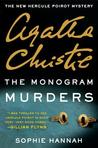
The Monogram MurdersThe Monogram Murders by Sophie Hannah
My rating: 3 of 5 stars

Re-incarnations of detectives in hands of a different author seldom succeeds, except in the case of Holmes, but that was possible maybe because the reincarnator was Sir Doyle himself. But, apart from that exception re-incarnations are meant to be not as successful as the original. The stories of limited success are limitless. Take James Bond, John Gradener or Jeffrey Deaver, the books still didn’t read like a Fleming Bond. Recently Asterix suffered the same fate. Yes, the return of our favourite heroes albeit does keep us hooked, but, at the end of the day neither those books nor The Monogram Murders left me with a satisfied smile.

First lets dissect the book purely as a crime thriller. On that point the book would score 3 or 3.5. I love twists, no doubt about that. But nothing tastes good when it is heaped upon a reader without any limit. The number of twists in this book got to me. By the end of the book they didn’t seem like twists at all. A definite case of trying too hard. The plot seemed a bit awkward. I cant put my finger on it, but somehow this was definitely not an EVIL UNDER THE SUN, not even a HICKORY DICKORY DOCK. The plot never slowed down, it was fast, but sometimes it got too fast to really comprehend what was going on. But at the end of the day, the twists of the double plot, and the solution at the end turned this book into a decent crime thriller. There were no pretensions, and though the solving of the crime was left to some circumstantial evidences, the ending was neat.

Now as far as the book goes as a Hercule Poirot novel, the book scores a big ZERO for me. I don’t know why, but this Poirot never felt like the Poirot I had read before. But it didn’t started that way, the man was getting into the Poirot shoes when suddenly the character became an impersonator instead of the real egg shaped Belgian. No, this man is definitely not the HP I knew. And somehow Catchpool, really didnt fit my idea of Hastings. I rather hoped that Hannah would bring back Hastings along with HP in this book.

Lastly, I respect Sophie Hannah. This was not an easy task. Not only did she have to churn out a twister but she also had to re-create the famous Hercule Poirot. Not every venture succeeds but a courageous move should be saluted. So, I salute Ms. Hannah for trying to bring back my favourite detective to me. Though I might not have enjoyed as much as I would have like to, I would still not lose hope. Maybe the second book, if there is any, will bring back the old Poirot I knew.


View all my reviews

Tuesday, 24 June 2014

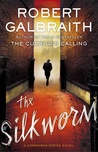
The Silkworm (Cormoran Strike, #2)The Silkworm by Robert Galbraith
My rating: 5 of 5 stars

When Val McDermid reviewed the first Robert Galbraith novel, she praised the book saying that it incorporated the best of the traditional mystery fiction and private-eye pace. The first one was good, but the second one was prone to get bogged by the 'Second Book Syndrome'. But once again proving Val McDermid’s opinion right, nothing as such happened, and the book proved to be fast and highly entertaining. Cormoran Strike, professionally busy and more famous after solving the Lula Landry case, gets a visit from a lady who wants her writer husband found. She needs him for the daily expenses, and also needs him for their daughter who is distraught without him.

The book was long. A bit too long for the kind of plot it featured, but thanks to the style of narration the process of reading it never seemed boring. Most long crime novels falls into the trap of over emphasizing the human psychology, the relations between the characters and other stuff which doesn’t help the plot a bit. Galbraith did incorporate these “human” layers in the book, like the relation between Robin and her fiancé Matthew, or the strange but enjoyable relation between her and Strike (wonder where that will go in the next book), but they never got out of hand, and came in the way of the plot. Every time I felt that maybe the conversation between the two characters is getting long enough, the writer presented me with a scene which bears a direct relation to the main plot. Page skipping was not an issue with this book. The plot, though nothing ground breaking was stable and the ending was done in a way that the crime doesn’t get solved through circumstantial evidence. The common plot and motive, and the length of the book could have made the whole thing boring, but the pace and non-deviation from the main plot turned it into a highly enjoyable piece of crime fiction. And the crime described was awesome. If the Nordic writers thought that they could be gory and brutal, then they do have a serious competitor here.

The characters were well drawn but again keeping in mind the nature of the book which is ultimately a crime novel, these developments were shown through their actions. They never made me yawn and ponder whether this book is a crime novel or a class in character development. Page long description of characters and chandeliers ala P.D. James style was never my cup of tea. The way they spoke, or the way they acted spelled out whether they are a bully or they are in awe of themselves. Even the description of the victim’s daughter was done through a series of dialogues and scenes where Strike and Robin tries to question her for clues. The description was potent enough to be heart-breaking.

The main point is, J.K. Rowling CAN WRITE. She has proved it over and over again. The Potter maniacs will vouch for that, the people who loved the process of filling up the casual vacancy would vouch for that, and now us crime fanatics would vouch for that too. So, there was never any doubt that these books featuring strike would be anything but good. Yes, I did have a sense of anxiety as to how she will handle the plotting, but with these two books she has really laid my fears to rest.


View all my reviews

Friday, 23 May 2014

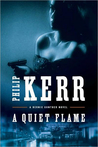
A Quiet Flame (Bernard Gunther, #5)A Quiet Flame by Philip Kerr
My rating: 3 of 5 stars

Some books are never meant to be happy. Although in a Crime novel the outcome, most of the time, provides a solution to a crime, and brings a criminal to justice, but often it also leaves the reader with sadness. Either connected to a character, or to the general atmosphere created by the book. A QUIET FLAME by Phillip Kerr left me sad, and on both the counts of character and atmosphere. The book dealt with a theme which was dark from the very beginning. A case involving disappearance of missing girls is dark enough, but when this whole nasty business is coupled with a the Nazi pogrom of massacring Jews, and the infamous but never acknowledged Directive 11 as promoted by Juan Peron of Argentina the book becomes a ride, which not makes the reader uneasy but leaves him with a sadness. At least it left me sad.

But, if judged from a POV of a crime novel, this book can be called mediocre at its best. The atmosphere was electric, the way Kerr jumped between Berlin and Buenos Aires was impressive. The fear, the uncertainty and the hatred portrayed by his words that were present during the 1930s, as the Nazis are on the verge of gaining power was very potent. But sadly, although these may add to the general feeling of a crime novel but it can never substitute the real plot. If the plot is shallow then no amount of Nazi, Peron or Argentina can save the book and that’s what happened for me with this book. Bernie Gunther as a protagonist had the right mix of scepticism and quick wit, but even he with his smart mouth wasn’t good enough to salvage the plot.

The plot when it started had great expectations oozing from it. It had the quality of a plot which starts with a bizarre crime and ends with a solution and motive equally bizarre and believable. But here, somewhere in between numerous jumps between periods, and more than enough characters, with one overlapping the other the plot lost its fizz. And the ending, or the part of it when it arrived almost went past me, before I realised that I had just read one solution to one of the subplots. And then the act of joining one subplot to the other and connecting the solutions to both through a single character was once again equally bad. It spoke of huge amount of coincidence. And I don’t like much coincidence in my crime novels.

On its own this book would get 2 stars out of 5. But, as I said the side dishes of atmosphere and history was very tasty, on an average I upped my rating to a 3 star.


View all my reviews

Sunday, 13 April 2014

The Seven Wonders (Ancient World, #1)The Seven Wonders by Steven Saylor
My rating: 4 of 5 stars

THE SEVEN WONDERS by Steven Saylor, is a prequel to the series of historical Crime fiction, Roma Sub Rosa, featuring his Roman private Eye, Gordianus. Set in around 110 B.C. this novel is set in a time when Gordianus had just attended manhood, at the age of 18. On becoming a man, as decreed by law he sets sail with Antipator of Sidon, who is travelling incognito for reason best known to himself (which eventually gets revealed in the last chapter). The novel set in a format of a collection of short stories sees Gordianus visiting the seven wonders of the Ancient worlds with Antipator. Every city he steps in adds a new chapter to his life, as well as bringing a new problem for him to solve, thereby adding to his experience which would make him a trained Finder in the coming days.

One thing that struck me while reading this book was that though being marketed as a mystery, this one comes out more strongly as a travelogue. With an undercurrent of mystery present in every chapter. Steven Saylor was himself a student of history, who wanted to write a literary fiction based on Rome, which by chance and good luck of the readers got transformed into a series of crime novel. So, it doesnt comes as a wonder that the descriptions of the places which remain till date(only the great Pyramid), and the ones which were present during the days of Antipator, not to forget those which werent there in 110 B.C. as well ( the Hanging Gardens) were such vivid and wonderful that it overshadows the crime solving part, thereby turning this into a very enjoyable account of the travels among the ancient Seven Wonders.

But what is so admirable, also takes away the shine from Gordianus, the protagonist. The vivid imagery created through words about the places visited, pushes Gordianus to a side character. Though enjoyable as a protagonist, with every chapter springing a new lesson in form of a woman, man or a crime, he never becomes as powerful a character as say Brother Cadfael or Marcus Falco. Throughout the book he remains in the shadow of either the travelogue or his master Antipator. Antipator of Sidon, though a real human being who lived, is presented here as the teacher of Gordianus. This character is much more vivid though the presence he gets in the book is less than his student. Travelling incognito he creates an aura around him with his wisdom and poetry. Even when his reason for change of name is revealed, one cannot stop from feeling sorry for him, and for Gordianus as well.

A well written book, which if read with an open mind stating that this should be read as something more than just a mystery novel, will be enjoyed by all.


View all my reviews

Wednesday, 19 March 2014

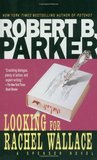
Looking For Rachel Wallace (Spenser, #6)Looking For Rachel Wallace by Robert B. Parker
My rating: 3.5 of 5 stars

LOOKING FOR RACHEL WALLACE by Robert B. Parker, found Spenser being asked by a publisher to play bodyguard duties to a feminist-lesbian-activist-writer who had started receiving threatening calls the moment her new book had hit the stands. Although as one would discover that those calls were warranted, as the writer in her book exposed many a corporations and people in high places being biased towards women, gay women in particular. Spenser takes up the job, and within the first few minutes starts having personality and verbal clashes with his client. He manages to hold on, only to be fired later, because he saved her from getting thrown out of a corporation premises by a couple of baddies who meant to throw her out for giving speeches to their female employees, which actually went against their policies. Rachel Wallace called Spenser a male chauvinist pig trying to work his way using his brute force, Spenser argued back that he was only doing his job. Spenser gets fired, goes home, only to learn later that Rachel Wallace has been kidnapped. Always the dutiful man, he goes to the police station and offers his services, and eventually manages to find out where Ms. Wallace is, and who was holding her.

Did I enjoy the book? No, I didn’t. Did I hate the book? No, I definitely didn’t either. So, why didn’t I enjoy? Well, for a piece of crime fiction this book had a plot which was low/too low on the suspense/mystery quotient. As much so, this one read like a police file on a kidnapping undertaken by an amateur, only to be solved within hours. The book in toto, had just one real suspect, and it was this person who turned out to be the kidnapper. Not really too captivating as a plot of crime writing. But, it could have been different. Robert B. Parker could have used the threats related to the book to disguise a more sinister motive behind the kidnapping. And presented with a criminal whose motive for the crime was totally different from what he wanted us the reader to believe it was i.e. the threats related to the book were just meant to be red herrings. Spenser would have ripped through that smoke screen to unveil the real criminal and the deeper darker plot. That would have been more Spenser-esque. But instead we got stuck with one terribly foolish criminal, a bad mouthed opinionated victim who got on my nerves with her whining about being victimized and ‘All MALE are pigs’ dogma who fires the only man who was good enough to protect her, and then gets kidnapped. Thank GOD for Spenser and his dialogues!!!

So, why did I like reading it? Well does anyone need a better reason than Spenser? The book had Spenser in it, so were his lines. No need for a better reason for liking the book. The omnibus edition I was reading had a caption which said “Before Reacher there was Spenser” which I totally disagreed with. Reacher is Reacher, and Spenser being Spenser is a class apart. I like Reacher, but I worship Spenser. At times the Lee Child man comes as too unbelievable to believe that all he says and does can make sense even as a work of fiction, but that’s not the case with Spenser. Every line, every action attributed to this man makes me believe that had there been a real man called Spenser, he would have been churning out the same lines as written in the pages.

And, lastly the pace. Yes the plot was bland, but the pace was too good to turn the book into a yawnathon. Every crime writer should take a lesson from this man as to how to write a book this fast. I did not enjoy ‘Promised Land’ either but even with that book the pace blew me apart. Time by time Robert B. Parker is becoming one of my favorite authors, and thank god I still have ‘Hush Money’ on my shelves ready to be read.


View all my reviews

Sunday, 23 February 2014

Promised Land (Spenser, #4)Promised Land by Robert B. Parker
My rating: 4 of 5 stars

I started reading Robert Crais’ Elvis Cole novels a few months back, and from the very onset I was hounded by reviews which complained Cole being a copy (albeit a poor one) of Robert Parker’s Spenser. The reviewers complained(or remarked) that the tongue-in-cheek dialogues coming out of Cole’s mouth were too much of a copy of those coming out of Spenser’s mouth, and they didn’t sound original. I was intrigued and by the second Elvis Cole novel I was tired of Cole, and his, what I considered a desperate attempt to sound smart-ass, “cool” attitude. And from that moment I wanted to read Parker and Spenser, if not for anyhting else, just to find out what kind of a character this Spenser is, whom Cole is supposedly imitating. Thus came PROMISED LAND and with the book came a realisation as to why Spenser is Spenser, and Cole, in atleast his first two novels was just a copy of him.

This is not my first Robert B. Parker novel. I had read MELANCHOLY BABY featuring Sunny Randall, and found it to be a book which was pleasant to read, but was not worth remembering for a long time. PROMISED LAND and I will remember this book for a long time. Not for the plot or the characters as a whole, but for a protagonist named Spenser and his partner named Susan Silverman. They are a couple. I cant describe the way they speak, or the way Spenser was made to speak. But, Robert Parker successfully created a protagonist, who is fun to read about, who is serious when it comes to matters relating to heart and client, who reads a lot, and who delivers his dialogues in a way to make me wish that I wish I could deliver lines like Spenser. Not for a single moment he or his character seems boring, over the top, or a smart-ass who is trying to hard to sound cool. The lines come out of his mouth, as if those lines are the most normal lines in the world and they are Spenser’s birthright. Hats off to the late great Parker.

But, I was disappointed with the plot. Actually I anticipated one with more element of mystery in it. A whodunit where Spenser uses his skill finds out a criminal who had committed a crime. This book was much of an adventure where the good and the bad guys were pointed out early and they stayed true to their colour. The ending was also the one which was anticipated, but what made this book a fun read was obviously Spenser, and the speed which made this “know all” adventure fast and not boring.

And, Hawk who starts out as a bad guy, but ultimately turns out to be a ‘sort’ of sidekick to Spenser. With Mouse and Joe Pike(another Cole connection) Hawk adds up to my list of another ‘sidekick’ who left on their own has enough ammo to overshadow the main guy.

P.S. Crais and Cole brought out their originality from the third book, and despite leaving their second book unfinished I raced through the third instalment and finished it with a contended sigh. Finally, Cole found out that he doesn’t need to be a shadow of Spenser, because left on his own he is himself that good.
.


View all my reviews

Monday, 3 February 2014

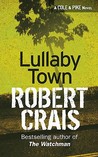
Lullaby Town (Elvis Cole, #3)Lullaby Town by Robert Crais
My rating: 4 of 5 stars

Finally the Robert Crais I can say I enjoyed reading. This is my third Crais book featuring Elvis Cole, but by far this is the best and the most interesting. The first one was okay, and I thought that by the second book, I would get to know and like Cole and Crais better, but the second book fell flat and I ended up not being able to finish the book. I was bored, disgusted by the ever smooth talking Cole, and confused by the plot. Cole’s wise-ass attitude got on my nerves and I was desperately searching for the reason as to why these books are considered as masterpieces of crime writing. I was entering another PD James phenomena.

But, this third instalment of Cole and Pike got my attention, and made me realise that maybe there is substance in this series after all, and that one book blunder doesn’t make this series bland. LULLABY TOWN by Robert Crais stars when Elvis Cole is hired by hotshot action movie director Peter Alan Nelsen to find his child and ex-wife, the ones who he had dumped on his way to stardom. Cole finds them easily and then discovers that the lady has a secret of her own. She enlists Cole and Pike’s help to get her out of the situation and at that moment in comes Nelsen with his ego in his wake to jumble things up.

Starting out the plot had really no aspect of being a whodunit. By one-third of the book the reader gets to know the plot, and the players, and comes to realise the outcome. All the points revealed, along with the solution the book had the risk of falling flat. But that’s where Crais brings out his magic wand and creates a piece of crime writing which would keep the readers hooked just for the sake of knowing how the solution was reached. The pace of the book, his writing style, the dialogues, the scenes he created all made up for the lack of suspense and made this a highly enjoyable and satisfying read.


View all my reviews

Wednesday, 22 January 2014

The Snatch (Nameless Detective, #1)The Snatch by Bill Pronzini
My rating: 4 of 5 stars

As it happens that the modern world of crime fiction is full of silly protagonists with even sillier names, Bill Pronzini in the year 1971 decided to create a protagonist without a name. And, thus started the series of private investigator crime fiction featuring NAMELESS. And, truly the first book in the series shows us the depth of the statement, “What’s in a name?” because without a name, NAMELESS comes out as an original, one of a kind tough guy, who in his own admission is a not a hero, but who is just a cop. And like other true cops sees fighting crime as his duty.

Gary, the 9 year old son of millionaire Louis Martinetti, gets kidnapped from his school. And then Lou gets a ransom demand of three hundred thousand dollars. To deliver he calls upon Nameless. He takes up the job, and on the anointed time goes for the drop. In the process he gets mugged, and slashed by a knife. Eventually managing to get to a hospital he realises that both the money and the kid is gone. Nameless accepts Martinetti’s offer to work for him, and in the process finds out the kid and solves the mystery.

Going by the benchmark of a crime novel, the book is a standard whodunnit. Laced with subtle twists, the plot is fast and believable, with a reasonable ending. The character of Nameless is what grabbed my attention. Without a name he comes out as a person whose emotions, fears, sadness could be related to. I could personally relate to the emotions behind his love for pulp-magazines, or the sadness he feels when his relation goes to the docks made me feel sad too.

A must read for any crime fiction fan. Nameless and Bill Pronzini are both stalwarts in the world of crime fiction. And not reading his work is almost a capital crime.


View all my reviews

Monday, 20 January 2014

Devil in a Blue Dress (Easy Rawlins #1)Devil in a Blue Dress by Walter Mosley
My rating: 3 of 5 stars

Starting this year everyone around me started accepting reading challenges like a fearless Gladiator, while I was still stuck, mostly, with the books I had bought way back in 2012 and 2013. Most of these books were from writers I have tasted before. So, with a determination and a sense of adventure I created my own reading challenge of getting to know as much as new crime writers as possible. New as in the sense, that I am experiencing his work for the first time, and not necessarily the author is a debut writer. So, with this target in mind, I picked up DEVIL IN A BLUE DRESS by the celebrated African-American novelist Walter Mosley.

The book introduces Ezekiel a.k.a Easy Rawlins, an African-American WW 2 veteran who finds himself being handed the pink slip by the owner of the aircraft factory where he had a job. Jobless, and facing a mortgage payment he wanders into a bar owned by his friend Joppy, who in the process of helping him introduces to a white man called Mr. DeWitt Albright who tells him that for a price he might have a job for Easy. The job would be to find out the whereabouts of a white girl called Daphne Monet. Standard PI job. Easy takes the money, goes out looking for the girl, and finds himself deep in the woods with gangsters, persecuting police, racist white men and a bundle of lies and deceit from almost everyone. Up to his neck in troubles, he calls his old friend from Texas, Mouse Alexander a.k.a. Mouse. Mouse happens to be a trigger happy gangster who wouldnt hesitate to kill his friend Easy, if he stood between Mouse and a bag of money.

Purely from a Crime fiction point of view, the book was too confusing without a dynamic ending to justify the confusion. The confusion was mainly due to the presence of innumerable characters who barely had single pages dedicated to them. Had the plot, which did have some nasty shades to it, or the motive or the climax, been more awe inspiring, then the confusion might have added to the pleasure of reading. But with a standard plot, and a not too fast speed the confusion did what it does best, it confused me. I had difficulty in keeping up with character names, who they were, and what purpose are they serving in the plot. But, the plot as I said earlier was a standard PI plot, meaning that it wasn’t bad. Yes it wasn’t great, but it did have the element of suspense as its very difficult to figure out the main motive or the culprit beforehand.

Easy Rawlins is a laid off black man, who lived in the days when racism was nothing to be ashamed of. Black skin meant that “a man will always be called boy”. So, being a PI with no training or experience meant that it would be hard for him to survive. And it was hard. He faced opposition from authorities, saw how a white man can treat him like a dog without ever saying a mean word. So, in the process he called his friend Mouse, of whom he is afraid. Now this is a peculiar relation between a main protagonist and his sidekick. Most of them have a buddy or a love-hate relationship, but none of them have a chemistry where the main guy is frightened of his sidekick. Here, Easy is frightened of Mouse. And, as he is without any experience Easy tries out his connection within the community for clues instead of the standard procedures of a PI like hounding the authorities or searching files or looking up for fingerprints.

So, will you read this book? Yes, you should, as this book is an important part of Crime writing. There are very few credible African-American protagonist out there. Easy Rawlins is one of them. And, if you are not a fan of crime writing you can atleast read this book to see what it actually felt to be a black man back then, or at times even now, especially in my country, India.


View all my reviews

Tuesday, 27 August 2013

Bullet for a StarBullet for a Star by Stuart M. Kaminsky
My rating: 5 of 5 stars

There is a certain pleasure, which I get, while reading fiction filled with original events and characters. This phenomenon was limited to my WW 2 or Cold War spy novels where actual historical figures were made to appear in the books, given dialogues, and scenes. Stuart Kaminsky’s “Bullet For A Star” his first novel to feature the 40’s era Hollywood based private detective Toby Peters, had the same theme, but with a different colour. Here instead of political figures, the men to feature where actual movie stars of that era. The main plot itself is based on the actor Erroll Flynn, while Humphrey Bogart, Jack Warner and at the very end Judy Garland makes cameo appearances.

The plot centres on Eroll Flynn. Someone is trying to blackmail him, as the studio agrees to pay the blackmailer, Peters is called upon by Warner Brothers to make the payment on their behalf. The whole scheme goes wrong as Peters is blindsided, and soon he finds his gun missing, him a murder suspect with dead bodies piling around him. As far as the plot goes there was nothing in it, which has not been written before. But, there was this added factor of the real actors which added a dose of extra pleasure while reading. There is a scene between Peters and Bogart which would go down as one of my the most favourite scene of all times.

I will certainly recommend this book to everyone. This is not only for crime readers. Stuart Kaminsky, kept his book short and made it interesting. In his part he created a plot centred on living figures, which never turned into a parody. This is by far one of the best P.I. books I have read in recent times.


View all my reviews

Monday, 12 August 2013

The Monkey's Raincoat (Elvis Cole, #1)The Monkey's Raincoat by Robert Crais
My rating: 3 of 5 stars

The Monkey’s Raincoat is the debut effort by much celebrated American crime novelist Robert Crais. The novel features his protagonist; Vietnam Vet turned Private Investigator, Elvis Cole and his business partner and sidekick Joe Pike.

The novel starts with Ellen Lang, who comes to Crais’ office asking for his help in finding out her husband Mort and their son Perry. Mort was supposed to pick up Perry from school, but neither the husband nor the kid ever reached home. Crais’ writing style baffled me. Frankly speaking, the over-the-top quirky dialogues were not helping me. They seemed unreal and glib. Reading them made me feel that Crais and Cole were both trying too hard.

The plot was not much on the suspense quotient. By 3/4th of the book the plot ceases to have any suspense left in it. But, Crais’ managed to portray Ellen Lang’s troubles and her process of developing her self confidence in a credible manner. The action scene in the climax was good. It was good enough for me to read through the whole scene without skipping a single page.

All in all, a decent debut effort from a famous author. For me it wasn’t a Great Read but it didn’t disappoint me either.


View all my reviews

Monday, 29 July 2013

The Cuckoo's Calling (Cormoran Strike, #1)The Cuckoo's Calling by Robert Galbraith
My rating: 5 of 5 stars

“And still there is space for books that defy categorisation, books such as Robert Galbraith's new The Cuckoo's Calling which embraces the best of traditional mystery fiction, private-eye pace and the kind of writing that reminds me why I love this genre.”
Val McDermid, The Guardian

Once a certain Sparkling author had recommended to his fans a book about a girl gone to some place. The book turned out to be a marriage manual, though somehow it was marketed as a thriller. After that incident I was very weary of famous writers recommending books, specially thrillers. But then I found Val McDermid speaking her mind on The Guardian, now this is an author I respect. She has her notes right most of the times she speaks, So, with her recommendation and edging from a friend of mine I decided to pick up one of the most talked about book on this year “The Cuckoo’s Calling” by Robert Galbraith.

What was the plot all about? Nothing fancy, it was about a distraught brother asking Cormoran Strike, the protagonist, to find out the truth behind his sister’s suicide, which according to him had a more sinister shade to it. Strike, limping, dumped by his fiancé, without a home and broke, finds his salvation in this case and his “GIRL”-wonder called Robin. And as McDermid put it so clearly in her essay in the Guardian, the story chugs forward smoothly embracing the best of traditional mystery fiction, private-eye pace and the kind of writing that reminds me why I, i.e, Me, love this genre.

The ending wont floor you, it’s not an ORIENT EXPRESS or a chilling Scandinavian Thriller which would either start your head spinning because of the twists or would make you feel sick because of the gore. Its simple, and its straight. And, this is something I enjoyed, for a first time novelist there is always urgency or rather a desire to write something that would twist the ending into something totally unexpected, and most of the time making it rather funny or boring. Galbraith hasn’t gone that way, rather he opted for an ending which although being somewhat expected, had that perfect amount of that “UNEXPECTATION” which made me say “Somewhere I suspected him as the culprit, but never really believed he could do it”. Now that’s good crime writing. Making the reader feel that he is an expert too, and in the same vein retaining that perfect amount of suspense just to prove him right and making him feel the pleasure of knowing the unexpected.

Cormoran Strike, he is unique, but with a little shade of Jack Reacher. Can’t help, can we?? After all they both were military police. He is gruff, he has failed in love and he is broke. He has a persecuting stepfather, and a cruel ex-girlfriend. He needs a case badly, and he gets one, but his salvation comes in another form. In form of ROBIN, his girl-wonder. NO love lost or romantic liaisons between them, she had just got engaged. I love these characters, and I love them more when they triumph against all odds to show that not only its possible to win under any circumstances, but it’s also that Crime Writing will always entertain me.

Lastly, I am frightened, will this be the only strike of Cormoran we will ever get? After all, the writer will be busy filling up casual vacancies left by untimely death. But then again, she won’t have to spend time on her magical pursuits, now that the boys and girls have grown up and those snakes and monsters have been killed. So, I can lay back and feel the afterglow of a great session with a good-ole type crime novel, and safely feel that this is not the end, and that Robert Galbraith though being angry at his real name being revealed will surely pick up the pen to strike us again.

P.S.
1. I guess this is what happens when the following equation is laid down:
Sue Grafton(Private Investigator) + Lee Child(Military Police) + J.K. Rowling(?????) = Robert Galbraith.

2. I never wasted a word on the writing style of the author. Cause neither I am an expert on writing style, nor I have the credibility to question Rowling’s style of writing. But, if you still want to judge how she writes, read her Harry Potter books, or get yourself a copy of Casual Vacancy.


View all my reviews

Saturday, 22 June 2013

Melancholy Baby (Sunny Randall, #4)Melancholy Baby by Robert B. Parker
My rating: 4 of 5 stars

Sunny Randall is no Kinsey Millhone, but thankfully she is no Crodellia Gray either. So, even thought she might not get herself a permanent place in the female Fictional Gumshoe Hall of Fame, but she would definitely not earn a place for all the wrong reasons, like some of her counterparts.

Melacncholy Baby by Robert B. Parker, featuring Sunny Randall, a private detective, starts when she is approached by a girl, who wants to find her biological parents. The girl, Sarah Markham, is convinced that the couple, who had raised her, was not her bio-parents, and that she was adopted.

The book was short, and the plot, not being too complicated or over the top, was tight. Left on its own the plot accounts for 70% of the total pages in the book. The other 30% belonged to Sunny’s personal problems. Her divorce and its aftermath, and her decision of taking help of a psychiatrist. Though not related to the main plot, these pages gelled nicely with the investigation and eventually added more credibility to the character of Sunny Randall.

Though not as famous as Parker’s other creation, the Spenser novels, this book evolved as a fast and uncomplicated read.


View all my reviews