Showing posts with label Amateur Detectiver. Show all posts

Thursday, 19 February 2015

Mistress of the Art of Death (Mistress of the Art of Death, #1)Mistress of the Art of Death by Ariana Franklin
My rating: 5 of 5 stars

For me there are always two kind of successful crime novels. One that has a tight plot, a modus operandi of the protagonist which flushes out the culprit from amongst the rubble. A novel as such, might or might not have a very potent ambience attached to it. The reader might not feel connected to the setting in which the events take place. The descriptions might not be that vivid. But the fact that the novel delivers a potent plot with a strong ending makes up for these shortfalls and ultimately turns the book into a successful crime novel.

The second sort is, the one which has a strong ambience to back up a plot which is not that twisted, neither the deduction powers of the protagonist gets called upon to point out the culprit. The culprit almost flushes himself out. But, the reader almost gets carried away to the time and place where the novel is set. The writer not only presents the reader with a landscape but also shows the mentality of the people living at that time. The potency is strong enough to overcome the shortfall of the plot.

Mistress of the Art of Death by Ariana Franklin falls into the second category. Here we had a novel which managed to encompass three geographical entities into one novel. She brought into the pages of her novel, Cambridge, Salerno and the Middle East all in the setting of 1100s. She gave a short but detailed panorama of the early crusades. She then proceeded to tell us readers, how the Salerno School of Medicine allowed female practitioners in their ranks. Actually this is what I like with historical crime fiction. Even if the crime quotient gets a bit low at times, these books never cease to educate me in terms of history.

But, I expected a bit more from the plot and how it ended. Had this been a run of the mill plot where a king is threatened and the knight is called to save him, I wouldn’t have minded. But, Ms. Franklin laid down a plot which featured gory child deaths, a female coroner, old thirst for vengeance carried over from the crusades. She bought in the Jews being persecuted by the Christians, she introduced a masked devil called Rakshasa. I had expected that the end would come through shifting of clues and finally pinpointing the devil and then a showdown in the last chapters. Unfortunately that didn’t happen. But as I said earlier, the atmosphere compensated for this shortcoming.

A must read for any crime fiction lover, with a serious soft spot for this sub genre.


View all my reviews

Friday, 5 December 2014

Sovereign (Matthew Shardlake, #3)Sovereign by C.J. Sansom
My rating: 5 of 5 stars

Three things I fear when I start a book. A book which is not borrowed but bought from my own savings, a book which with these three points can spell “Yawanathon” for me and can literally throw me into financial ruin for investing in a worthless adventure. Those three points are,
1. The author’s proclamation of being a HUGE fan of P.D. James (God rest her soul in peace).
2. A book which is 660 pages long, with long paragraphs.
3. A blurb from Colin Dexter which speaks about the book’ other aspects, but doesn’t mention how good is the mystery.
And thus justifiably frightened and with an apprehensive attitude I started SOVERIEGN by C.J. Sansom, and within a first few chapters I found out that despite all the above three points being present I am starting to enjoy the book. And the book proved to be such a marvel that after a long time I broke my own rule “If a book is not finished within a week, then it’s too boring too finish..ever, so skip to the next book” and took 16 odd days to complete this marvellous piece of crime fiction which is set in the times of Henry VIII, the middle age Lothario.

This book is a revelation. How many protagonists do we come across who gets bullied, beaten and threatened by every bad guy in the town, including the King. This guy, Matthew Shardlake does. He is just a lawyer and he gets bullied and shaken by high ranking bada**, and like a normal human being he endures those insults instead of throwing caution to wind and challenging the lot, like some “fictional” protagonists with “fictional” abilities would do. When laughed and mocked at, due to his physical deformation, unlike some wise crack hero who uses wit to counter every remark, he silently suffers and at times vocally protests. He is shown to be a human, yes a clever one, but a human after all who feels sad, suffers when laughed at like most of us. Cudos to Sansom for creating such a character. And not to forget his assistant Jack Barak, a faithful companion who is outraged when his master is mocked, but gets angry when the same master questions his fiancé, but runs all over London just to save his master. Another very human character.

Lastly the plot, mashed with the historical atmosphere was something I lapped up like a hungry dog. Being a silent lover of history thrust into finance, I love to read these historical mysteries. I don’t complain if the historical part overshadows the mystery, but Sansom kept enough history, his descriptions of the reform, and King henry or the greed of Sir Richard Rich were very potent, never made it boring, and silently threw in a plot which is fast, which pits a man low in social strata against villains much higher in the pecking order, he exposes the man’s fears and the villain’s greed all within the framework of a tightly woven plot, and when the finishing pages starts arriving he unleashes twists after twists which is worthy of a standing ovation.

So, though I am sad of Dame Phyllis James death, I can never call myself a fan of her works. But, I am surely, from this day, counting myself as a fan of one of her fan, C.J. Sansom.


View all my reviews

Friday, 12 September 2014

Mr. MercedesMr. Mercedes by Stephen King
My rating: 3 of 5 stars

This book was so long, with so many pages that mid way I was wondering that whether I will be able to finish this book, ever. And with the added pressure of both the culprit and the hero known, the urge to go on was dimming slowly but steadily. But, I finished it. And, I wont say phrases like “Thank God I finished or else I would have missed out soooo much”, coz there wasn’t any missing out to be even had I decided to skip the last 300 odd pages. The culprit would have remained the culprit, and the hero would have remained the hero. Nothing would have changed, except maybe I would have missed out on HOW the villain was bashed(literally) and how the heroes saved the day.

The Mercedes Man was 300 pages too long. The book didn’t have any fault as far as the plot goes, or the way in which the culprit is brought to justice. The fault lies in the fact that though being portrayed as a go-by-the-rulebook ex-detective Bill Hodges suddenly decides to play the lone crusader. Not stopping at that he manages to drag a 17 year old juvenile, and two relatives of a victim dragged into his fight. One of them gets blown up. Then again there was no reason to show how Hodges gets gooey with the lady who gets blown. Neither was that needed, nor was there any reason to kill of a character. But, as due to some of his twisted logic since Hodges had decided to make this fight personal, the death of Janelle, the involvement of Jerome suited the plot. But, they didn’t make sense.

This was my first Stephen King novel. And, though there were loopholes in the plot, I can really see why this author is considered as one of the best. If for nothing else I finished the book for his style of writing. Normally I just enjoy the plot of a novel, paying not much attention to the other details. But, the way King describes Holly and her troubles, or for that matter Hodges fight with his retirement (though both the situations have become much used themes in crime novels) kept me hooked.

This book is supposed to be a part of a trilogy featuring Hodges. I might not have been to upbeat after reading this instalment, but I can surely say I will pick up the next one the moment it comes up on the shelves.


View all my reviews

Friday, 18 July 2014

The Sins of the Fathers (Matthew Scudder, #1)The Sins of the Fathers by Lawrence Block
My rating: 5 of 5 stars

In this short length debut of Matthew Scudder, prolific author Lawrence Block introduces a scene where Scudder is seen offering money to a police officer in exchange of information on a case Scudder is working. When the cop hesitates to take the money, Scudder deftly gives him a short but effective advice on why should he grab the money, and why him not taking the money might cause serious jeopardy to the his career. To that the cop replies that he guess he has a lot to learn. This scene told me first-hand that why Block is considered to be a class in crime writing, why Scudder stands apart from the pack of PIs working in the world of crime fiction, and lastly why a lot of “celebrated” crime writers has got a “lot to learn” from Block when it comes to crime writing.

My version of a perfect crime novel, this book incorporated everything that makes a particular book or a series successful. The book had pace, it had quality and when the ending came it was like coming down from a roller coaster ride which you have rode earlier but was equally enjoyable this time. As far as the plot goes, the whole concept was nothing new; in fact this same plot has been used over and over again. But, somehow Block turned this same old wine into something exotic by sheer speed, a hugely enjoyable and fascinating protagonist and by shedding any extra fact related to the plot, and presenting the whole book devoted to the crime and its solution. Not a single page was not somehow related to the plot. Not a single moment did it cross my mind to skip a page or a paragraph. Books like these never make into a top-100 lists or something like that, instead we get trash(disguised as highbrow crime fiction) listed in those lists.

And lastly, Matthew Scudder, a revelation. An ex-cop, who left the system after he got burnt in it. A PI without a license, a no-nonsense man with a streak of violence in him. A divorcee with two kids. The man could have just turned into another gloomy clichéd American PI. But, thanks to Block he doesn’t. How many protagonists do we have in this world of crime writing who tells a cop to accept money in return for information? Who tells a gay bar-owner to bribe the city police chief in order to make him raid his place and arrest the troublemakers, or drops two hundred dollars into church’s poor box? Not many, but Scudder does. This man along with Morse, Poirot and Millhone is sure to go to the top of my list of favourite protagonists.


View all my reviews

Tuesday, 8 July 2014

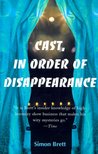
Cast, in Order of Disappearance (Charles Paris, #1)Cast, in Order of Disappearance by Simon Brett
My rating: 4 of 5 stars

Simon Brett is a prolific writers of whodunnits, with four series and more than 30 books to his credit. So, whenever I am toiling my way through an insanely slow and boring book which I decide to not to finish, I pick up one of his books, which instantly provides me with a sense of satisfaction, which I get from reading a good work of crime fiction.

Charles Paris, a mid 40s theater actor, the protagonist of this book is approached by an young girl, who wants him to be a bridge between an aging superstar and herself. She was besotted to him, even a few days back, but recently she got the boot from the old man. And now she is receiving threatening letters from the old man. So, as far as the plot goes there was nothing new to be found, but since I was not searching for anything new but something stable, I was more than happy with the pace and the line of the plot.

Like an economical medium pacer the book kept its line and length intact, and managed to survive without many down points or yawn moments. Yes, the pace was slow if compared to today’s style, but this was not a gory Scandi thriller, thereby breath-taking pace was never needed. The subtle humor, present in almost all Brett novels was very much present. But, the best part of it all was that the writer never made Paris to look like an official amateur detective. All along the plot he maintained a stance which showed clearly that he didn’t have any official authority to snoop, but did that just because somehow he got caught up in the whole mess.


View all my reviews

Tuesday, 10 June 2014

The Body on the Beach (Fethering, #1)The Body on the Beach by Simon Brett
My rating: 3 of 5 stars

Simon Brett who won this year’s CWA Diamond Dagger for his contribution to the Crime writing genre is known for his mysteries which is surely defined as “Cozy mysteries” in todays standard, but would have been dubbed simply as “Mysteries” in the years gone by. Among his numerous series’ this one features two middle aged woman in the village of Fethering. Carole Seddon and Jude (just Jude) are neighbours. Carole being a woman with a stiff upper lip and Jude being the proverbial Happy-Go-Lucky. Carle discovers a dead body while taking her morning walk along the beach with her dog, Gulliver. As a dutiful citizen she calls up the police and reports the body, but the police arrives questions her only to inform her that they found no body on the scene. Following this event, Carole gets threatened by a woman with a gun, and another body, that of a child is discovered the next day. Carole confides in her neighbour, and together the two women starts digging within the upper-class Fethering society for the truth.

The book is almost entirely devoid of gore or bloodshed, which was pretty fine by me, as I don’t like useless gore and blood which has no need whatsoever for the plot to move further. But, what the book had in the true Golden age Crime fiction style was the pre3sence of a tight plot which propels the book forward. This being a straight forward crime novel, all reference to “psychology” and other deeper matters were not touched, which was again fine by me, and as a result we get to know very little about the characters including the protagonists, which suited the plot fine. And as it is a style of Simon Brett to keep his protagonists shrouded in somewhat mystery, this book was no different. Like Mrs Pargeter, one of his other protagonists, we hardly get to know much about Jude, not even her surname. She is shrouded in mystery but comes around as a woman who loves her life, and also brings in a sort of freshness to the somewhat boring life of her co-protagonist Carole Seddon, who unlike Jude is given a thorough background.

A definitely enjoyable read. Though a bit slow, but this book will be enjoyed by anybody who is looking for a light read between reading “HEAVY” novels.


View all my reviews

Wednesday, 21 May 2014

The Dead in Their Vaulted Arches (Flavia de Luce, #6)The Dead in Their Vaulted Arches by Alan Bradley
My rating: 5 of 5 stars

“Mother,” I whispered. “It’s me—Flavia.”

And thus starts the sixth instalment of the acclaimed Flavia De Luce mysteries by Alan Bradley. As Flavia and her family awaits the return of her mother on the platform of Bishop’s Lacey, a train carrying her mother arrives. Along with the train a man comes and speaks a few words into the ears of Flavia, and then falls under the train to his death. Flavia caught in between her grief, her family and the man’s words, sets about in a dangerous and ground braking task, only to unmask the person responsible for her mother, Harriet’s death.

This is a sad, sad book. The indication was there that this might be Flavia’s last year at Buckshaw. And this turned every line of humor into sadness, as every such line made us reader realise that this is the last time the girl will say such words in Buckshaw. The mention of Gladys made me wonder how the thing will cope without Flavia, or for that matter Dogger, Mrs. Mullet and Esmeralda. But, this is also a novel of retribution, of revenge, of coming face to face with one’s destiny. Flavia gets to know why she is hated by her sisters. She comes to know how she got her Christmas wishes for new glassware, every year without hitch. She flies on Blithe Spirit just like her mother. She finds out what her father thinks about her. Most of all, she finds out who The Gamekeeper is. She finds out what her destiny has in store for us as the youngest girl of a De Luce family. This novel makes a little woman of Flavia out of the girl.

The original book deal for Mr. Bradley was a 6 book deal. So, in a way there was a sense of fear that this might be the last Flavia. But thanks to the brilliant talent of Mr. Bradley the book deal has been extended into a 10 book deal, and in a recent interview the author stated that he is well into the seventh book. The seventh book will be something every Flavia fan should and will look forward too. With different settings, and a grown up and more matured Flavia entrusted with the secrets of her family, will be a different ballgame altogether. But, whatever it may be, but keeping faith in Alan Bradley and Flavia Sabina De Luce, one can place a safe bet, that the seventh book wont disappoint, and if anything would surpass the previous six.

Though a hugely enjoyable book, but for reader who are new to Flavia De Luce series, for them I would suggest that they take up the series from the first book to get the true flavour of Flavia.


View all my reviews

Sunday, 11 May 2014

A Red Herring Without Mustard (Flavia de Luce, #3)A Red Herring Without Mustard by Alan Bradley
My rating: 5 of 5 stars

"I was the platinum. It was going to take more than a single opponent to overcome Flavia Sabina de Luce."

Every new book in this highly entertaining series by Alan Bradley brings a new wave of smile across my face. Surely this series has to be one of the best-est and the freshest of all the crime series to come out in the recent years. Flavia De Luce grows more and more adorable as the series progresses. With her amusing interests in poison, her very distraught life being hounded by two sisters and her oh-so-heartbreaking longing for her mother Harriet, makes this book much more than just a crime fiction. This almost becomes a sort redemption of the crime writing genre from the standard factory produced books featuring meaningless violence, cliched sullen heroes trying hard to be witty, and something which is given the name of a plot without having any instance of ever being one.

Compared to this Alan bradley writes books, which are a homage to the traditional British Golden Age crime novels. Are they “relevant” in today’s time? I dont know, and frankly i dont care. They are according to me a very god example of what a crime novel should look and read like. To be precise, if a crime novel doesnt have a plot, a motive and twists then no matter of “relevency to modern times” can make it a crime fiction worth mentioning.

Take the example of this book, “A Red Herring Without Mustard”. From the very begining the plot introduces a character who is hated by another character. Within a few chapters the character gets assaulted. No sooner we have gone a few pages up, than we are gifted with a murdered body. And all through the protagonist Flavia is busy trying to clear the mess created by forgery, assault, lies and murder. Except maybe a few pages where she plans her favourite pastime of revenge on her sisters, or she tries to stop the tears that comes up to her eyes when she wonders why her sisters are so mean on her. But apart from that she searches for clues, analyses clues and at the end points out the culprit. And, what makes this book a blazing success is the presence of so many characters. A crime novel with many chracaters equals to confusion which equals to twists which equals to a great crime novel.

So, everyone, who hasn’t already met Flavia De Luce, please please pick one book and go through it. Just like me you won’t be disappointed.


View all my reviews

Friday, 9 May 2014

Mrs. Pollifax on SafariMrs. Pollifax on Safari by Dorothy Gilman
My rating: 3 of 5 stars

Somehow for a long time, I have got disconnected with the spy fiction genre. It’s strange but in fact it was this genre and the writings of Frederick Forsyth, Colin Forbes and Robert Ludlum that made me realise my unhealthy addiction towards thrillers. But, somehow I don’t feel the same affinity with the modern spy thrillers. With their over use of gadgets and other technology I feel left out. And also the whole concept of one man fighting terrorist and uncovering political conspiracy over and over again without his cover as a spy being blown, is not digestible. For me a spy thriller served as standalone novel is the best way.

Mrs. Pollifax and her “spy” thrillers though fall in the category of a series, but still manage to hold my attention till the last page. The reasons being, a fast plot with a nice twist in the end, a very modern style of writing without extra long paras or flowery language. Even the methods used by Mrs. Pollifax to solve the crime or ferret out the criminal are traditional without much emphasis on the use of gadgets. And, lastly for the protagonist, Mrs. Pollifax herself. Not a spy in the traditional sense, much more of a information collector in this book, she gets embroiled in the thick of things and uses her skills a\to come out of the whole affair unharmed and victorious. For me she represents a perfect example of what Miss Marple would have been like had she lived in USA in the 1980s.

Though not as well read in recent times as these books by Dorothy Gilman should be, the writer and her series does form an integral part of any crime fiction lover’s bibliography. A thoroughly enjoyable and fast read, like most of the books in the series.


View all my reviews

Wednesday, 7 May 2014

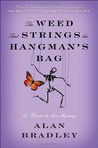
The Weed That Strings the Hangman's Bag (Flavia de Luce, #2)The Weed That Strings the Hangman's Bag by Alan Bradley
My rating: 5 of 5 stars

The second instalment of the series featuring Flavia De Luce, starts of at a zooming speed when a visiting puppeteer in the village of Bishop’s Lacey falls to his death. Flavia starts to poke where she shouldn’t, but couldn’t stay away from, and discovers that the fall is not an accident and actually the murder is linked with a suicide of a boy who died 5 years ago. Cute meets Crime meets a nostalgic feeling featuring Miss Marple in this very enjoyable whodunnit .

One of the best aspect of this series aside from that it features a adorably cute 11 year old as its protagonist, is that it brings back the Golden age feeling of crime novels where the crime took place in a village, and the suspect pool was comprised of the locals. And, most often the culprit was found among these locals. As with this book, the crime though committed on an outsider had a culprit who is a local. And, as most of the villagers were present in the narration from the very beginning the whole crime solving becomes a guessing game, where any person can come out as the culprit. I for one couldn’t really guess who the culprit was until Miss De Luce clears the cobweb and explains it all. After all as Sergeant Woolmer said to Inspector Hewitt,

“With respect, sir...it could be because we’re not Miss de Luce.”

And, lastly once again Miss Flavia De Luce. I pray to God that, Alan Bradley on a fine morning doesn’t takes up in his head to make her grow. It would just take away all the fun. Reading these books made me realise one great thing, that children are far more interesting than us boring adults. A standard crime thriller featuring a dour faced, down in the dumos police man would have just turned this book into another crime fiction. But, it was for Miss Luce that we got a series which stands out like a “HEALTHY” thumb among the sore thumbs. Where in a standard crime novel would we have got lines like,

“What did Flaubert mean,” I asked at last, “when he said that Madame Bovary gave herself up to Rodolphe?”
“He meant,” Dogger said, “that they became the greatest of friends. The very greatest of friends.”
“Ah!” I said. “Just as I thought.”


Or

“Experience has taught me that an expected answer is often better than the truth.”

Miss Flavia De Luce is one of a kind, and all credit goes to Mr. Bradley for creating such a lovely character, and not stopping at that, topping it up with plots which are strong, without much loopholes and a crime novel which is blisteringly fast, free of any unnecessary baggage and highly enjoyable to read.


View all my reviews

Tuesday, 6 May 2014

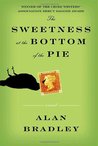
The Sweetness at the Bottom of the Pie (Flavia de Luce, #1)The Sweetness at the Bottom of the Pie by Alan Bradley
My rating: 5 of 5 stars

As someone growing up in Kolkata, I have been exposed to the Bengali brand of Detective novels from the very beginning of my reading life. These books almost always had a juvenile character, embroiled on his own or in the guise of helping an adult, in the thick of the mystery, trying to solve it. Though it was amusing at the beginning to see someone of my age fighting with culprits and solving crimes, but no sooner was I exposed to the crime writing of the west, then I started to realise what balderdash those so called “crime novels” were. And, the very thought of a policeman sharing clues with a kid was so disturbing that it almost took my mind away from the fact that those books had plots which could be easily used as a net to catch a shark. The holes were big, but not that big for a shark to escape.

So, when I found out that THE SWEETNESS AT THE BOTTOM OF THE PIE featured an eleven year old precocious girl called Flavia De Luce as its main protagonist, I had my doubts. The same old feeling of making a comedy out of a crime thriller. But, I took the plunge, and thank God I did. If finishing the book in two days flat wasn’t proof enough to show that I devoured the book, the fact that i have decided to read all the remaining books in the series one after the another must prove that I have fallen, totally and completely, in awe of Flavia De Luce and her creator Mr. Alan Bradley.

But, this is not the first time that a crime thriller with a child protagonist had garnered such rave reviews, and actually came out as a fascinating read. But those books, be it Blacklands by Belinda Bauer or Last Child by John Hart, were standalones. The heroes never got another shot at glory. Unlike here, where Flavia not only gets to solve the crime of a dead man in their house, Buckshaw’s cucumber patch and save her father, thereby rescuing two very costly and famous memorabilia, one of them belonging to King George himself, and also solve a cold case of suicide which turned out to be murder, but also gets the chance to set herself as a little Miss Marple meets Sherlock Holmes in a series of well read and well received crime novels.

Lastly, Flavia De Luce. I don’t know in reality how to live around a child as precocious as she is, but in these pages she comes out as a character who can bring a smile even to the toughest of men. Her dialogues, courtesy of Mr. Bradley, her experiments with chemistry (a la Dexter’s laboratory) and her penchant for helping her father come out of the jinx makes her one of a kind. And, also her memory of her mother, who disappeared when she was too small to remember anything. Those lines can only bring sadness in the reader’s eyes, showing behind that bubbly little sleuth there remains a little girl who misses her mom.

Poirot is dead. And, with him went away the proverbial village mysteries, to be replaced by sour faced detectives with ecclesial taste in music, Nordic policemen for whom laughing is as bad as having to lead a normal life. Poirot wont come back, but with Flavia, her sidekick Gladys and the village has definitely brought the Golden Age Mysteries back on the map of crime writing world. And this book could have well been called Sweetness ALL over the Pie!!!


View all my reviews

Friday, 21 March 2014

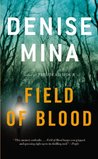
Field of Blood (Paddy Meehan, #1)Field of Blood by Denise Mina
My rating: 2.5 of 5 stars

THE FIELD OF BLOOD by Denise Mina is the first of the three book series featuring Paddy Meehan, an overweight female working in the city of Glasgow as a copyboy in a newspaper. The book is set in the 1980s, when a toddler called Brian Wilcox gets kidnapped and is found brutally murdered a few days hence. The police swiftly latches on to two 10 year old school students as the prime suspects. But, Paddy egged on by the sense of duty (as one of the suspects in a distant relative), and more importantly on discovering a link which the police overlooked, Paddy takes it upon herself to unearth the real criminal, as she gets confirmed that the police is working on putting the blame on the students thereby washing their hands off the case.

The author like many fellow Scottish Crime writers, Denise Mina used the city of Glasgow and its atmosphere along with the underlying tension between the Catholics and the Protestants to create a vivid background for the whole novel. But, still I can’t say that I am ecstatic about this book. My singular point is, this is Crime fiction and if the crime part along with the solve and motive falls flat, then the whole book falls flat. No amount of Glasgow or religious tension can save it, atleast in my eyes.

The plot was flimsy, along with the motive. The reason given as to why the kid got kidnapped was too bad to be taken seriously. The parents of the kid hardly get mentioned. The culprit before being nabbed got only a few paras of exposure thereby making him an unknown entity that falls out of the sky to be branded as criminal with conveniently placed clues. And then there were the, atleast 100 extra pages of a commentary on the real life crime featuring a man named Paddy Meehan. I still can’t get the point, as to why the author wanted this incident in the book, or more importantly why the editor saw that it’s important for the book. Other than providing inspiration to the protagonist Paddy Meehan, those pages served no other function.

Summing up, I give this book 2.5 out of 5 stars. Though heralded as the new Queen of Tartan noir, Denise Mina disappointed me with this book. The plot had potential, and the book with 150 pages short and a bit of twist in the plot could have been a better work of Crime writing.


View all my reviews

Wednesday, 19 March 2014

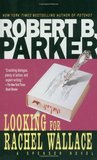
Looking For Rachel Wallace (Spenser, #6)Looking For Rachel Wallace by Robert B. Parker
My rating: 3.5 of 5 stars

LOOKING FOR RACHEL WALLACE by Robert B. Parker, found Spenser being asked by a publisher to play bodyguard duties to a feminist-lesbian-activist-writer who had started receiving threatening calls the moment her new book had hit the stands. Although as one would discover that those calls were warranted, as the writer in her book exposed many a corporations and people in high places being biased towards women, gay women in particular. Spenser takes up the job, and within the first few minutes starts having personality and verbal clashes with his client. He manages to hold on, only to be fired later, because he saved her from getting thrown out of a corporation premises by a couple of baddies who meant to throw her out for giving speeches to their female employees, which actually went against their policies. Rachel Wallace called Spenser a male chauvinist pig trying to work his way using his brute force, Spenser argued back that he was only doing his job. Spenser gets fired, goes home, only to learn later that Rachel Wallace has been kidnapped. Always the dutiful man, he goes to the police station and offers his services, and eventually manages to find out where Ms. Wallace is, and who was holding her.

Did I enjoy the book? No, I didn’t. Did I hate the book? No, I definitely didn’t either. So, why didn’t I enjoy? Well, for a piece of crime fiction this book had a plot which was low/too low on the suspense/mystery quotient. As much so, this one read like a police file on a kidnapping undertaken by an amateur, only to be solved within hours. The book in toto, had just one real suspect, and it was this person who turned out to be the kidnapper. Not really too captivating as a plot of crime writing. But, it could have been different. Robert B. Parker could have used the threats related to the book to disguise a more sinister motive behind the kidnapping. And presented with a criminal whose motive for the crime was totally different from what he wanted us the reader to believe it was i.e. the threats related to the book were just meant to be red herrings. Spenser would have ripped through that smoke screen to unveil the real criminal and the deeper darker plot. That would have been more Spenser-esque. But instead we got stuck with one terribly foolish criminal, a bad mouthed opinionated victim who got on my nerves with her whining about being victimized and ‘All MALE are pigs’ dogma who fires the only man who was good enough to protect her, and then gets kidnapped. Thank GOD for Spenser and his dialogues!!!

So, why did I like reading it? Well does anyone need a better reason than Spenser? The book had Spenser in it, so were his lines. No need for a better reason for liking the book. The omnibus edition I was reading had a caption which said “Before Reacher there was Spenser” which I totally disagreed with. Reacher is Reacher, and Spenser being Spenser is a class apart. I like Reacher, but I worship Spenser. At times the Lee Child man comes as too unbelievable to believe that all he says and does can make sense even as a work of fiction, but that’s not the case with Spenser. Every line, every action attributed to this man makes me believe that had there been a real man called Spenser, he would have been churning out the same lines as written in the pages.

And, lastly the pace. Yes the plot was bland, but the pace was too good to turn the book into a yawnathon. Every crime writer should take a lesson from this man as to how to write a book this fast. I did not enjoy ‘Promised Land’ either but even with that book the pace blew me apart. Time by time Robert B. Parker is becoming one of my favorite authors, and thank god I still have ‘Hush Money’ on my shelves ready to be read.


View all my reviews

Wednesday, 19 February 2014

The Cat Who Could Read Backwards (Cat Who..., #1)The Cat Who Could Read Backwards by Lilian Jackson Braun
My rating: 4 of 5 stars

Lilian jackson Braun, the American crime novelist whose mysteries featured the protagonist Jim Qwilleran(W coming after Q, and not U) along with the Siamese duo of Koko and Yum Yum published her first book in the year 1966, which was THE CAT WHO COULD READ BACKWARDS. She followed it with two more books in the series, but then suddenly disappeared from the writing scene, only to be resurrected by her publisher 20 years later to restart her much loved series to much fanfare. Had she been left in the cold with just three books to her writing credit, we, who love reading crime fiction would surely have been deprived of a great crime novelist whose books were fast, funny and had not only the presence of a great protagonist and his moustache, but also had two Siamese cats as problem solvers.

THE CAT WHO COULD READ BACKWARDS begins with Jim Qwilleran, a reporter, getting a job as an art beat for the newspaper Daily Fluxion. He starts his job by interviewing an artist who only paints babies, and in the process gets entangled in the art world filled artist with their egos and jealousies for fellow artists. He also gets to meet the reclusive and much hated art critic for the Fluxion, who had the nasty habit of getting on people’s bad book by writing vicious reviews about their work. No sooner had he settled into his job than a gallery owner gets murdered, and in the process Jim finds himself searching for the culprit.

The plot was the weakest point of the book, if the characters could be called the strongest. The plot was fast, and in no way could be described as boring. But, the ending didn’t justify the level of writing throughout the book. The unmasking of the culprit and the subsequent revelation of the motive did leave a slight bad taste in my mouth. But, having said that I thoroughly enjoyed the book, and plan to enjoy the other three books I have of the author in my collection.


View all my reviews

Thursday, 16 May 2013

Back Spin (Myron Bolitar, #4)Back Spin by Harlan Coben
My rating: 5 of 5 stars

Myron Bolitar is approached by an old man to help his daughter and son-in-law, both of them ace golfers, to locate their missing son. And, in return Myron’s Company is promised a deal with the husband-wife duo. Myron goes on his own to locate the missing child as his friend Win won’t help him on the case, and manages to recover the child and in the process opens up a can full of lies, both from the past and present.

With each passing book, I am gradually starting to regard Bolitar as one of my most favorite amateur sleuth. Why?
1. In today’s world of police procedurals and private investigators, Myron still holds on the old school charm of being an amateur sleuth.
2. He is normal. He has his sorrows but that doesn’t make him a cynic. Myron solves crime because he has to. He falls in love, he has his heartbreaks and infatuations, and all of these makes him a normal guy and not a booze addict clichéd cop, who doesn’t shave and has a streak of brilliance in him.

Coming back to the book, the plot was tight. For the first time 3/4th part, the plot moves in a steady pace. Though there are few adrenaline rush moments, but it never gets boring. The pace picks up in the last ¼th of the book, where the twists and turns starts coming up hard and fast.

A highly enjoyable and fast read, this book is recommended to anyone who wants to read thrillers featuring amateur sleuths, which is not over the top.


View all my reviews

Sunday, 12 May 2013

Slash And Burn (Dr. Siri Paiboun, #8)Slash And Burn by Colin Cotterill
My rating: 5 of 5 stars

“A good communist is like a tree. He stands firm but knows how to bend in a strong wind. He is fertile but gladly gives up his nuts to less fortunate creatures”

Slash and Burn, the eighth installment of the Dr.Siri mysteries, starts off when an American delegation led by Major Potter visits Laos, starting a joint operation to search for an American helicopter pilot who was lost during the war. Although presumed dead, a photograph delivered to the pilot’s dad, an American senator showed that he was still alive. Dr.Siri is asked to join the expedition. Then as a member of the team dies under unnatural circumstances, Dr.Siri smells foul and starts to investigate his death.

This was my first Colin Cotterill book, and I thoroughly enjoyed it. Very few writers have the talent of combing crime writing with humor i.e. write a crime novel which would not only be a page turner but would also make the reader laugh. The only name that comes to mind is that of the late John Mortimer, who along with his legendary creation Horace Rumpole created the same potent mixture of crime and humor, just as Cotterill did with his Dr.Siri mysteries.

Dr.Siri is one of a kind. He is an old pathologist who is fighting for his retirement. He is also an amateur sleuth in a Communist country, who doesn’t gives a damn about what the politburo might think about his comments towards Communism. Matching his wit for their own, is his wife Madam Geung, the noodle shop owner, and his friend Civlai, an ex-politburo member and Auntie Bpoo a transgender and a cross dresser, who also is an amateur poet. The plot without being anything extraordinary was twisted, and it also incorporated the events of the helicopter crash in a foolproof manner. The amount of blood and gore was low, rather nil, and the pace was sedate.

I thoroughly enjoyed the book and would recommend it to every crime fiction reader. Because I realized after finishing, that if you haven’t encountered Dr.Siri, your Crime Fiction experience isn’t complete.


View all my reviews